
A Trauma-Informed Approach to Binge Eating and Emotional Eating
Most of us have heard well-meaning advice like “just eat less,” “be more disciplined,” or “try harder,” only to find ourselves stuck in the same cycle of restriction, bingeing, self-blame, and exhaustion.
I understand, because I’ve been there too.
For women of faith, this struggle can feel even heavier – carrying the quiet fear that if we trusted God more, prayed better, or tried harder spiritually, this wouldn’t still be happening.

But what if the reason it hasn’t worked isn’t because you’re failing – physically or spiritually – but because your body learned a protective way of surviving that no longer feels helpful?
The Missing Pieces: A Whole-Person, Trauma- Informed Approach
Many nutritionists and therapists work in isolation, addressing only part of the picture. My approach brings together the elements they often overlook:
Eating Psychology
We explore the beliefs that have shaped your relationship with food – ideas like “fat makes you fat” or “I’m weak if I can’t stop eating.” These thoughts often deepen shame, especially for people who carry spiritual expectations of discipline or self-mastery.
Nervous System Regulation
Stress, anxiety and overwhelm can throw the body into imbalance, affecting digestion, metabolism, and food choices. We help you recognise these patterns and learn ways to restore calm and safety – so your body learns it can relax instead of constantly protect.
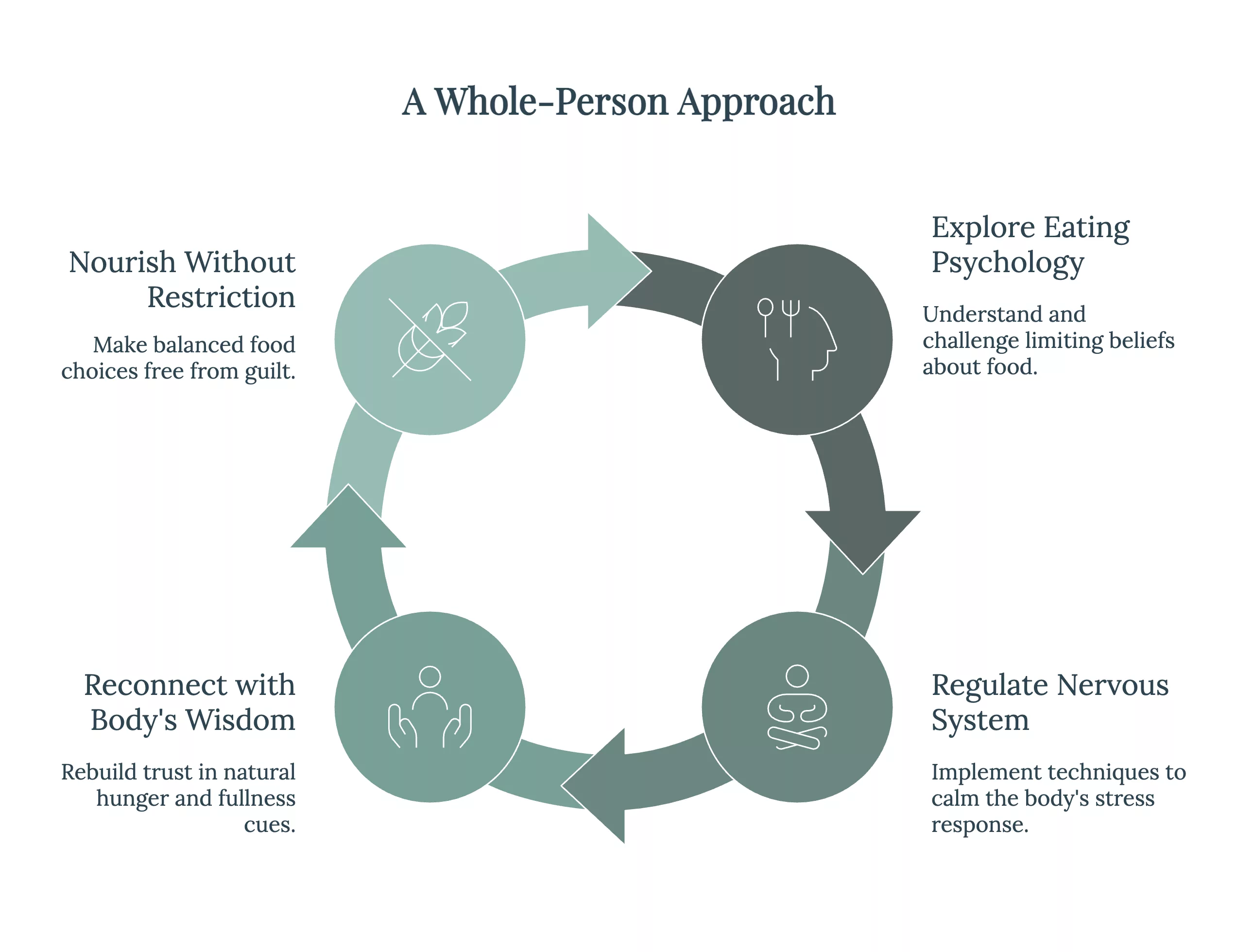
Reconnecting With Your Body’s Wisdom
Many of us have lost touch with natural hunger and fullness cues. Through gentle practices, you begin to recognise the difference between physical and emotional hunger – rebuilding trust in your body’s signals rather than dominating them with willpower.
Nourishment Without Restriction
Food should support you, not control you. Together we move beyond rigid rules and black-and-white thinking, choosing nourishment that feels good without guilt, shame or fear.

Food struggles are rarely about food
What we often call “struggling with food” isn’t really about food at all.
It’s about how your nervous system has learned to respond to stress, pressure, and emotional overwhelm – and how those patterns show up when life feels heavy or unsafe.
This doesn’t mean your body is working against you.
It means it adapted – wisely – to help you cope.
From this perspective, healing isn’t about control or correction.
It’s about restoring safety.
You don’t need more discipline.
You don’t need stronger faith.
You need safety.
Why slowing down matters
True healing doesn’t begin with force, discipline, or shame.
It begins when the body finally feels safe enough to slow down.
In my work, we intentionally move away from strategies that rely on pushing, overriding, or “fixing” yourself. Instead, we focus on helping your nervous system settle – because a regulated system is what allows new patterns to emerge.
For many women, this slowing down can feel unfamiliar, or even uncomfortable at first. We’ve often been taught – explicitly or subtly – that rest must be earned.
But rest is not a reward.
It’s a biological need and, for many, a spiritual one too.
How faith is held in this work
My approach is shaped by my faith, but never used as a tool to pressure or override the body.
I see deep alignment between trauma-informed healing and the heart of Christian faith:
grace over striving, compassion over condemnation, and rest as something God invites us into – not something we have to earn.
Here, faith is not used to:
demand more self-control
spiritualise shame
or silence what your body is communicating
Instead, faith is held as a source of kindness, permission, and grounding – a place where you are already enough, even in the midst of struggle.
What we focus on together
This work invites you to slow down – not to give up, but to listen.
Together, we gently explore:
how your nervous system responds to stress
how food has become a way to find safety, comfort, or control
how to rebuild trust with your body
how to soften self-criticism and shame
We do this through:
trauma-informed nervous-system support
somatic (body-based) awareness
gentle curiosity rather than judgment
pacing that respects your capacity
There is no rush, no pressure, and no expectation to “do this right.”
Healing unfolds as safety grows.

A final word
This approach isn’t about perfect eating, stronger willpower, or getting rid of struggle overnight.
It’s about creating the conditions – physically, emotionally, and spiritually – where peace with food can slowly take root.
You don’t need to try harder.
You don’t need to prove your faith.
You don’t need to fix yourself.